The following posts are translated from Swedish and are presented as part of a Master’s currently undertaken at Plymouth University. For anyone who prefers listening to reading I have added a recorded version of the text here:
Since the autumn of 2021, I’ve been slowly weaving my way through a Master’s in The Poetics of Imagination in the south of England. Much has happened along the way. Beautiful things — like me taking my first, stumbling steps as a storyteller. And more brutal ones — like the small arts college that hosted our course shutting down.
But the course refused to die. We fought to keep it alive and found safe harbour at Plymouth University’s Creative Writing program — bringing our own teachers and our somewhat wild syllabus with us. And so, this summer, I go to work on my master’s thesis, having chosen to focus on an ancient tale from the Yakut people of Sakha, Siberia.
Lately, I find myself wanting to write, in order to share something of the mythic world I’ve wandered into. The simplest way to begin is by writing here alongside my thesis, finding out along the way where the path leads. And as a starting point, to return to that autumn of 2021.
I had discovered that orally inherited stories gave me images and language for feelings I otherwise struggled to deal with. The planetary crisis, the biodiversity vanishing during my sons’ childhood years. A deep, unspoken guilt.
A kind of paralysis. And my own life entering a time and phase when bodies begin to fail, when parents and friends disappear.
My greatest inspiration at the time, Martin Shaw, offered an approach to stories that resonated with me. Stories are alive. They carry dignity, and a will of their own. To encounter a story is to enter an adventure you cannot control.
I dared not imagine, back then in my first autumn at Dartington Art College, that I would one day want to stand up and tell the tale of The Red Bead Woman. It’s a long, tangled story, with frightening elements. I did write about it though, in my first essay. And it has stayed with me ever since.
It all begins with an old woman’s yearning for a child. Alone with her five cows, Beiberikan lives in a black tent at the edge of the realm. One day, as she returns from the boggy pastures, she picks a horsetail plant. She wraps it in her softest cloth, sings to it, and lays it in her bed. From that tender, childlike gesture, the Horsetail Girl is born. And Kharjit-Bergen son of the realm’s greatest Khan is undone by her wild and haunting beauty.
Last Sunday, I told the story of the fate of the young lovers to Sagolabbet, our little story laboratory that meets from time to time in my freelance space at Kapsylen. Afterwards we made drawings, we spoke, we let the story ripple through us.
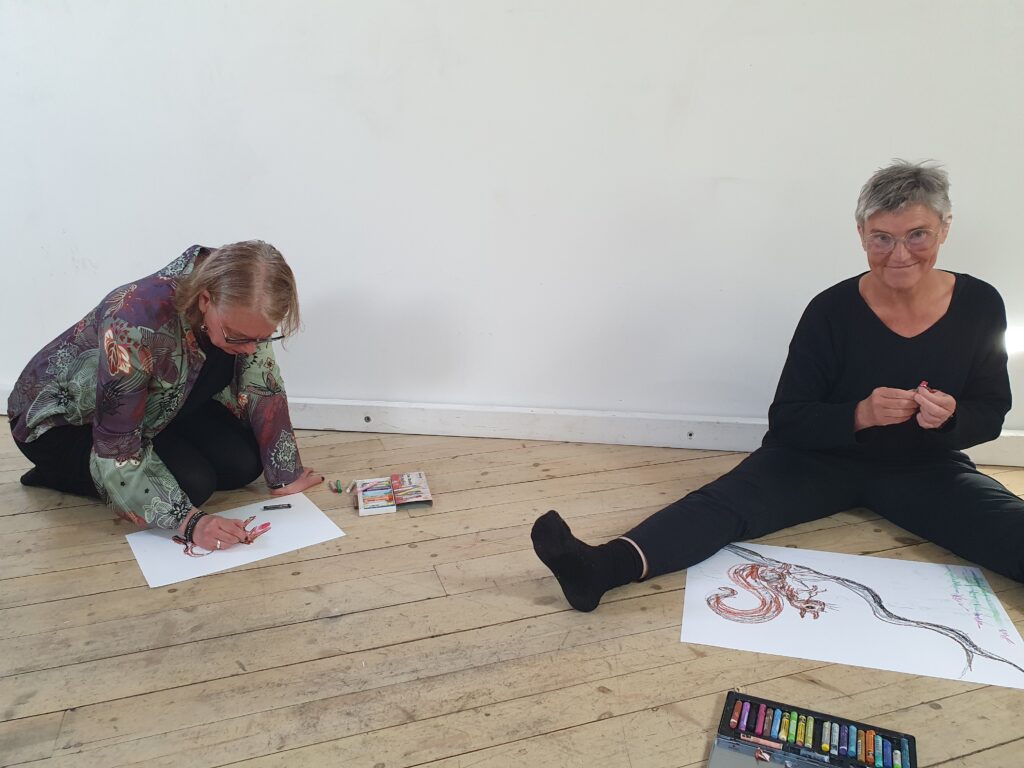
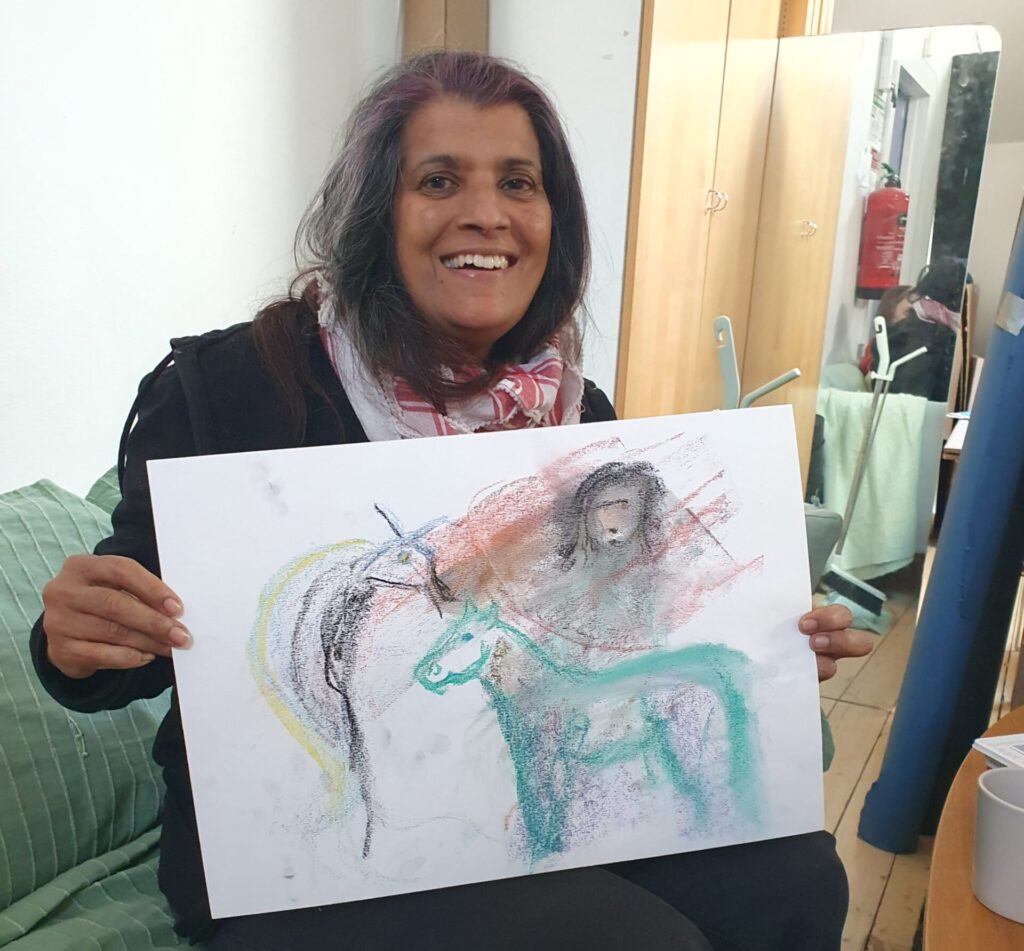
It is a brutal story. Beautiful. Complicated. And deeply filled with hope. We talked about how it speaks to becoming human, becoming truly oneself. So that, when the time comes, one can speak the truth. And this is where the horse that would not speak first comes into the picture.
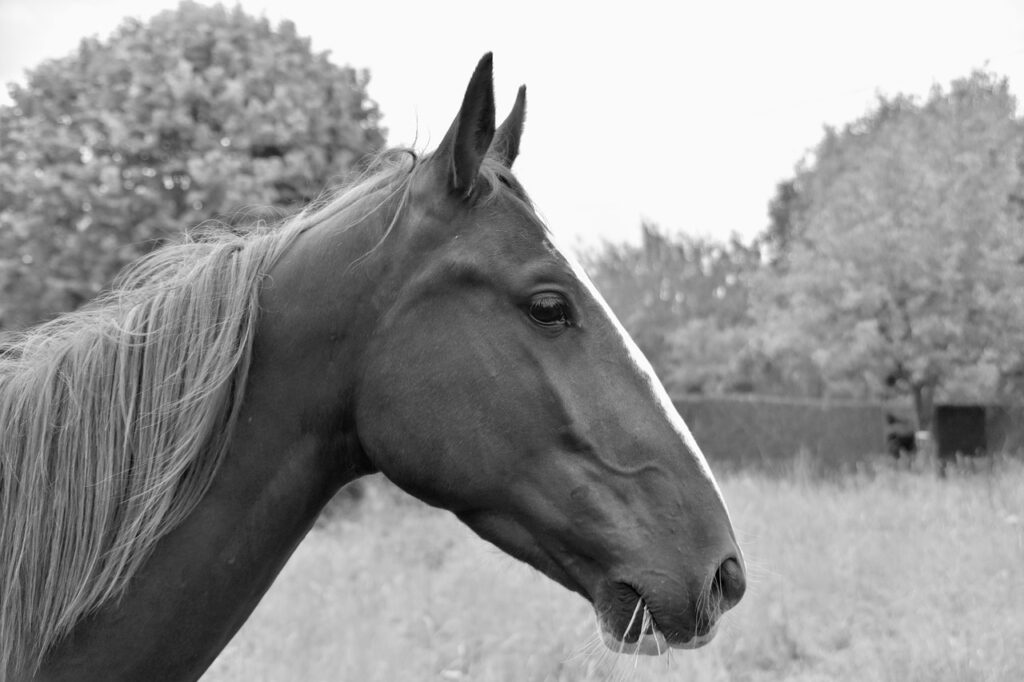
As a wedding gift, the young woman receives the last talking horse in the realm. It could have given her advice and guidance along the way but stays silent precisely when its voice is needed most. It is only later, when she begins to speak honestly with her foster mother about her experiences, that the horse too begins to speak. Deceptions unravel. Truths are told.
So, placing the horse in the title of my work helps me step into it. It allows me to be unsure. To falter. To be shy, or scared, or lost for words. Writing in another language has its challenges, especially for someone like me, who has long lived by carefully choosing words, shaping them, finding the right ones. But this story also whispers to me about courage, about daring to speak at all. And maybe you’d think that someone who has spent a lifetime telling stories would have no trouble finding her voice. But something new is stirring. A new way of talking that wants to step out into the world.
The Red Beads appear at the end of the tale, when the young woman who was once a horsetail plant finally finds her voice, and knows what she needs to say. They fall from her lips and are gathered and strung into a necklace by Kharjit’s sisters. A necklace that becomes a symbol to unite the realm.
And the horse? There remains a little mystery: Why did he wait so long to speak?
If you are reading this and find yourself in Stockholm or surrounding areas there might be an occasion for you to hear the story told live. Please write to me and we can find out if there is an occasion available for you.
Here you will find the easiest path to other posts in this series.
