I’ve said before that my Siberian tale carries a profound hope. A small stray dog performs the most beautiful act of heroism, but to tell you about it, I first need to take you where the story hurts the most. Perhaps it’s exactly because it leads me into fear and darkness, and then points to that radical hope, that I’ve come to love this story so much.
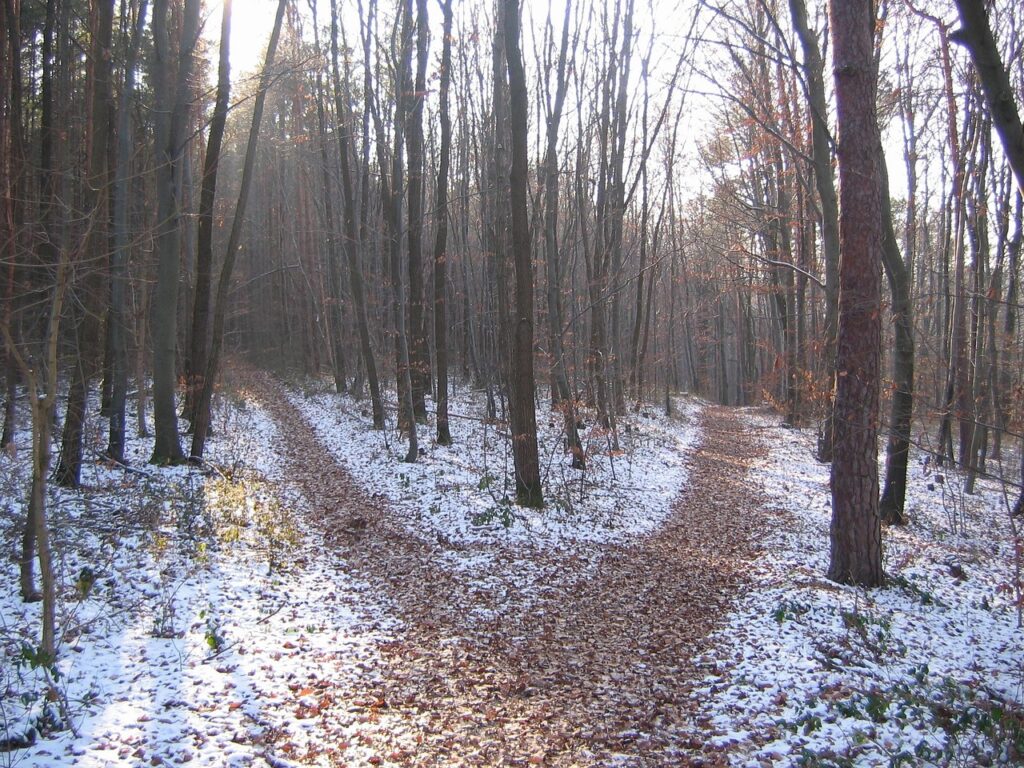
Do you remember her? The young horsetail woman, sitting on a talking horse at a crossroads as night falls thick around her. Her suitor suddenly had no time for her and left to go check his fox traps. She must now ride alone, farther from home than she’s ever dared in her brief human life.
Perhaps you remember how she came to be—how an old woman, longing for company, brought a plant into her tent. But when wealth and cattle arrived, the woman cared more for them than for the wedding of her adopted daughter.
Now the girl clings to the horse’s mane. A night owl flutters dangerously close. She tries to recall the young Khan’s words. Should she go left, or right? The horse remains silent, like herself. Even though, just like her, he must have heard the suitor’s overly precise instructions. Has he too forgotten them? Doesn’t he understand his role? Is he waiting for her to ask for help? Or does he know that what will happen is what must happen?
Because she does take the wrong path. And this is where we understand how new she is to human life, how untested she is. She does not question why the tent she spots ahead is made from iron, she does not pay attention to the smoke rising from the smoke hole being green in colour. A terrible witch steps out, drags her from the horse, tears off her wedding dress. With a claw-like hand, the monster rips off her face. Fastens it over her own with a piece of wire and mounts the horse. Rides off to the wedding in the bride’s place.
The stolen face connects this story to others from the Arctic. Kira Van Deusen’s book Kiviuq: An Inuit Hero and His Siberian Cousins is one of my sources for the horsetail woman’s tale—and there I find other examples of identity theft. The Inuit hero Kiviuq has a young wife whose mother steals her daughter’s skin. She hopes to take her place with the son-in-law. The mother uses her skills and experience from fox hunting to avoid damaging her daughter’s skin, but Kiviuq, who is a shaman, sees through the deception. In the Inuit versions Van Deusen presents, the men are not easily fooled. Our young Siberian hunter is less fortunate. The one who rides into town and takes the young Khan into her bed is no longer the woman he fell in love with.
And he cannot see beneath the stitched-on mask. Living with the witch he changes over time. Meanwhile, the horsetail woman lies in a ditch, neither alive nor dead. Only a small piece of her heart remains, and that’s when the miracle happens.
A small hungry stray dog sniffs its way to what the larger beasts have missed. And, despite its empty belly, places the tiny piece of heart meat on its tongue and starts running. Carries it through forest and steppe, through nights and seasons. Until he reaches the place near Beiberekan’s tent where the horsetail plant once grew. There, in the manner of dogs, he digs a hole. He drops the small heart fragment in, and pushes some earth on top. Then runs out of this tale and into another.
Beneath the soil a plant begins to take root. Rain comes and feeds the ground. The young woman is back in the realm of plants. Back in plant-time. She is to become one of the Light-Eaters, but for now, she remains in the dark.
To experience the worst and then return to life.
Of all the myths I encountered during my four-year course journey, it is the underworld stories that moved me most deeply. The descents. The goddess Inanna, hung on a hook like meat when she visits her sister in the land of the dead. King Gilgamesh of Uruk, mad with grief, running through the Sun God’s tunnel through the earth when he truly understands death for the first time.

A depiction of Gilgamesh’s beloved Enkidu. It is the grief over his death that sends Gilgamesh on his desperate search for a way to escape mortality.
I follow them through the brutality of their stories and out again on the other side, where reconciliation and deepened knowledge await. Inanna is rescued by two small androgynous beings showing compassion towards the underworld’s queen. Gilgamesh, in the end, accepts mortality and becomes a better king.
Some versions of this tale say it’s Beiberekan herself who dreams her daughter still lives and sets out to find and nurse her back to life. But I love the little stray dog. Here, in my sister’s version from the very first storytelling session in my studio space back in May.

This story, I think, has two descents. In the first, our heroine—if we may call her that—lies faceless in a ditch, devoured by forest animals. In the second, what little is left of her is laid tenderly in the soil and miraculously heals. Once again, she journeys through the plant world until she pushes up through the surface. Her horsetail tendrils stretch toward the light. And the transformation continues when Beiberekan once again carries her into the tent wrapped in the finest cloth. Old, hunched Beiberekan, tired now of the fifty cattle she had bargained for from the Khan’s household, is back to longing. And her daughter comes back. Only this time she speaks. Now I have something to tell, she says. She has found her voice.
What happens beneath the earth? Is that where she forms her words, her ability to speak? Or is language only born when Beiberekan is there to listen? Perhaps what happens in plant-time is different. Something other. Less accessible to us.
During my trip to England, I spent five hours alone on Dartmoor. Relatively alone I should say, since many of us were out there on the moors and hills, but anyway, the goal was to sink into a kind of plant-time. I sought places that seemed to want something from me. Told stories to spiders. Laid flat on rock slabs. Felt a bit silly and alone sometimes. Watched horses run wild among the rocks without reaching for my camera. Not at first. But in the end, I took a picture.
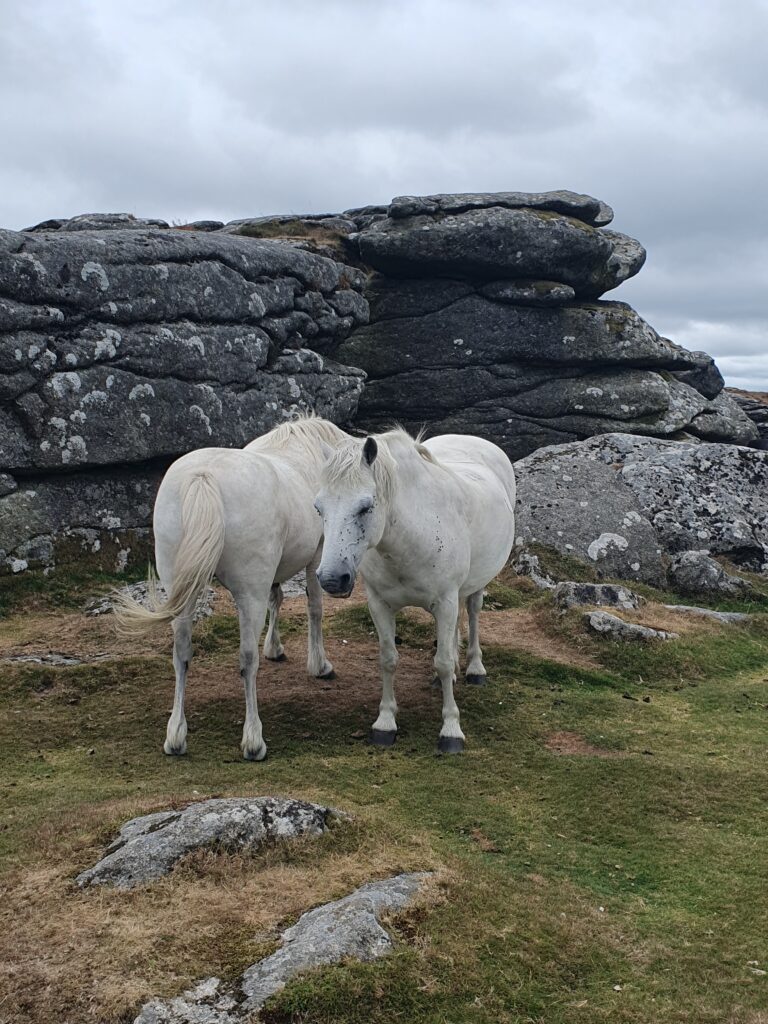
If, in this story, there is only one talking horse in the entire realm—what then must we do to make it speak to us?
Here you will find the easiest path to other posts in this series
