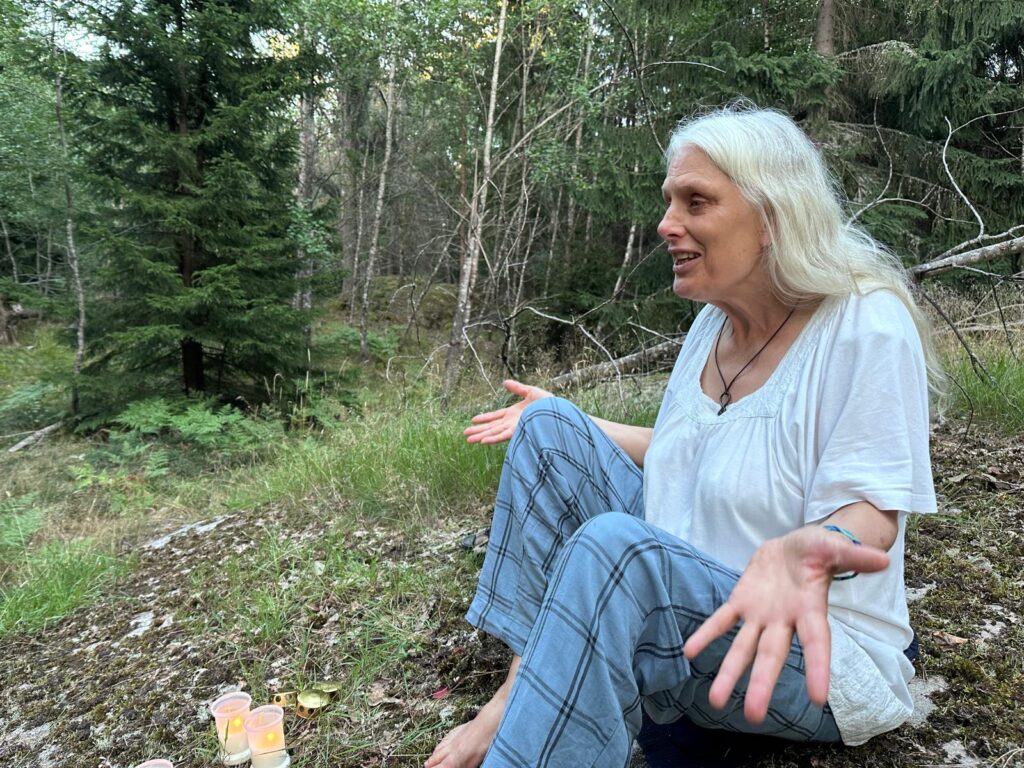
This series of blog posts also functions as part of my MA at Plymouth University. I translate most of my work into both languages but in this particular post English is dominating in both versions. My teachers, in turn, will be given a taste of the telling itself in Swedish. There is a space in between the languages where the body and its language live. I am hoping if you take part of my work, you will be able to fill this middle space with your imagination.
My whole process of delving into myth and story started out in a foreign language. When I arrived at the big final project, I decided to use this as an opportunity to translate all my experiences and newfound knowledge back into my own language. I wanted to be able to speak about myth and story in Swedish.
Then my teacher Valentin Gerlier pointed out that what I was really trying to do was to speak, not about, but with myth and story. Or from.
Prepositions matter. To speak with or from something or someone is a less individualistic endeavour. It is relational. I wanted to find my Swedish voice on these matters, and that was not something I could do in splendid solitude.
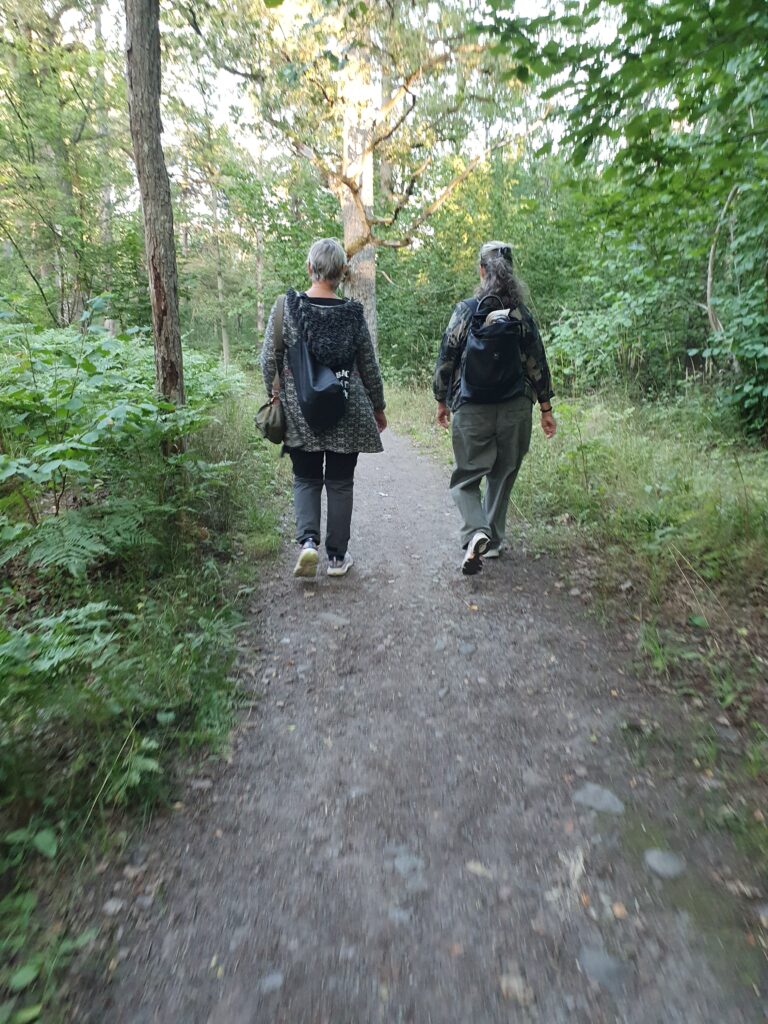
We took off into the forest, a few of my friends from Sagolabbet and I. We are a tiny community of fairy tale and mythology nerds slowly building something together. On the path I explained my quest to them and will try to do the same to you.
The talking horse in my tale from the Sakha people of Siberia does not speak his truth to the High Khan until the wounded and reborn heroine speaks her truth to her mother.
They mysteriously choose the same moment in the story to speak. I love this riddle. I have already asked why the supposedly talking horse did not speak up early enough to prevent the disastrous encounter with the sorceress. (Here in my third blog post) I have also tried to imagine why he stayed silent during a long winter in the Khan’s stables. More on this will follow. The tale itself does not answer the riddle for me. It is what it is. The horse speaks up when she does.
What if we need other creatures to find our voices? What if we need to be connected not only to our own selves but to others? To our surrounding world?
Me and a Horsetail plant
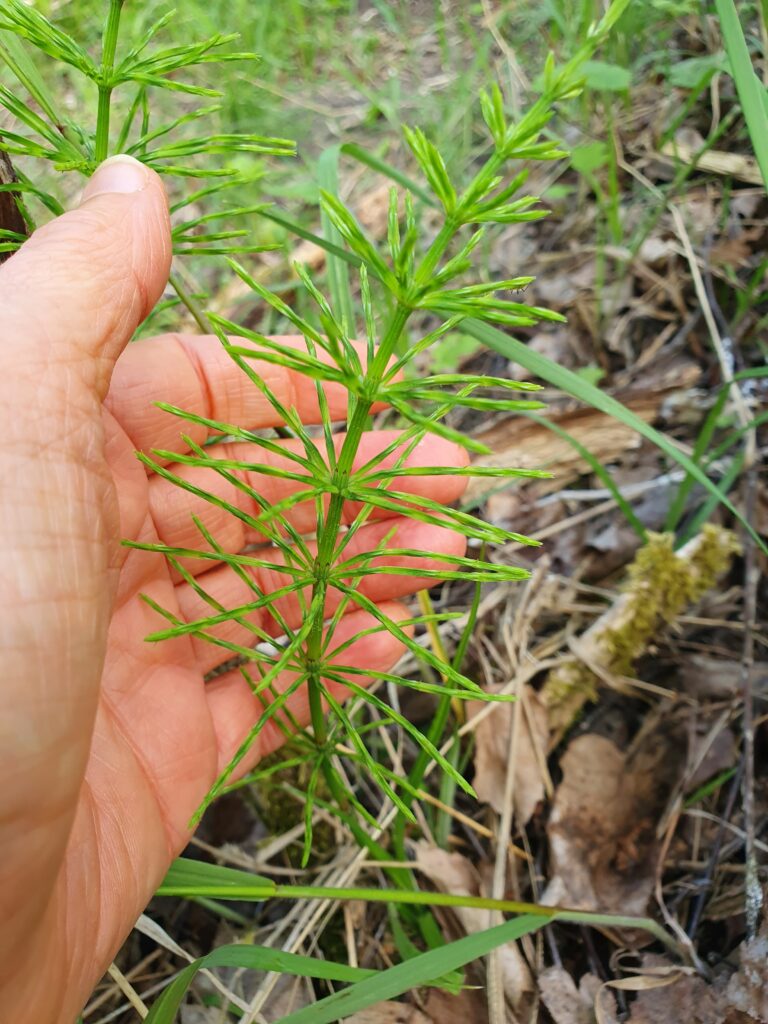
I have been contemplating the idea of voices for some time. Whose voice is really speaking in the story? If I do a telling, is it then my voice? Could there be other voices, from inside the story, telling their part of it?
Trying to understand the act of storytelling better I have returned to literature from the first module of the course I am on. Where we studied the oldest stories and focused on orality. These books are a treasure to me now as I understand so much more, having ventured further into the storytelling adventure. Martin Shaw, in A Branch from the Lightning Tree suggests that: ”The Mythteller somehow articulates the story from many positions”. And Sean Kane in Wisdom of The Mythtellers gives this perspective on oral narrative. ”It is told with a voice in which many other voices sound with unexpected ranges and resonances, reverberating with tones here and tones there until the whole story starts to sing inside itself.”
So, in my friends’ company, I played around with voices.
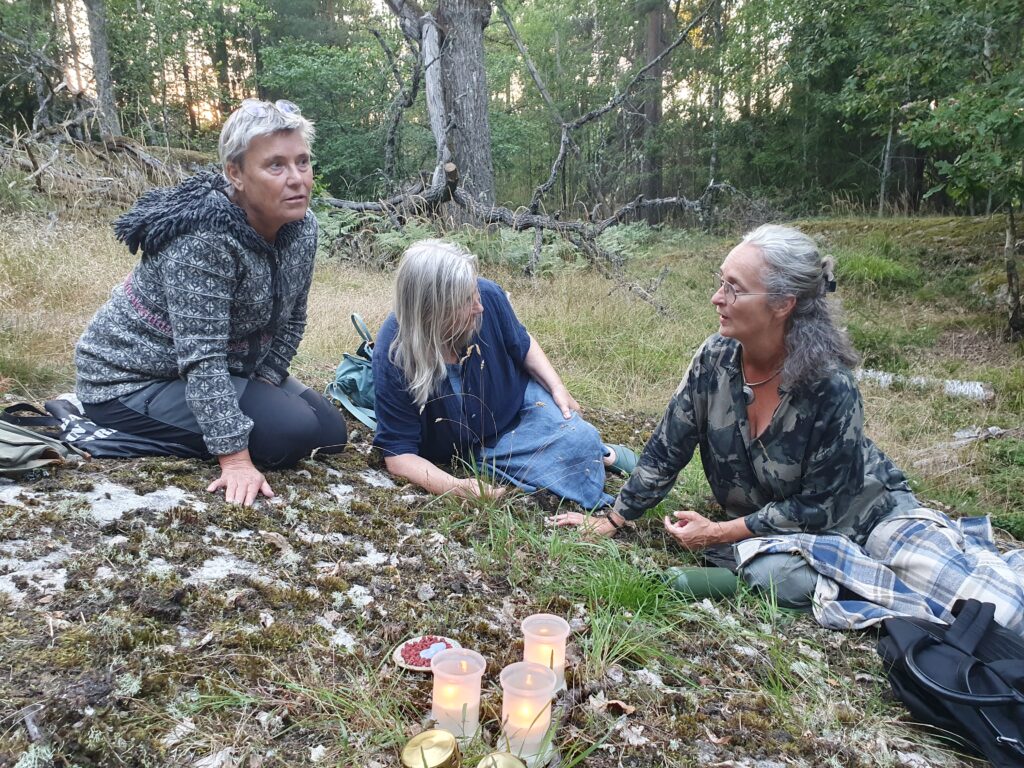
Anita, Kerstin and Janna have all heard me tell the full length of the story and have now agreed to come on a forest tour to help me do a recording. I have also called in some of my English fellow students to help out, sending texts over WhatsApp to Will and Mimi and receiving sound bites in return.
What follows is my experiment. Click the links!. And as always, the full story can be recapped in short form here. As a bonus the pieces from the forest also carry snippets of our conversation.
It is by The Iron Tent that our heroine, the plant girl, left to her own devices in the forest, has her face stolen and is thrown in a ditch. Cast aside and fed to the animals of the forest. But what if the tent itself could speak?
Beiberekan misses her daughter. Not knowing what has happened to her, the old woman contemplates life as she walks her daily routine. She has no idea that a tiny miracle dog has passed this way only days before. Carrying the tiniest piece of her beloved plant girl in his mouth and burying it in the earth before disappearing into another story. She only knows where to put her own two feet so that is what she is doing.
I could not write a voice for the talking horse. I would have felt like an intruder. His speech and his silence are the riddle I am dancing with. He was given away as a wedding gift. Then he was stolen. Now he lives in the stables of the High Khan and someone, The Stable Worker, is looking after him.
And then the truth is out. The wrongful bride is finally revealed as an imposter. It happens in the great hall, and someone is witnessing it all. This someone is The Pillar holding up the roof.
To liberate himself from the devilish influence of the sorceress the son of the Khan agrees to the old remedy suggested by the talking horse. He is being tied to a pole in the river Lena for a duration of thirty days and nights, then on to the top of the tallest tree to be blown by the four winds. For all of these days and nights his parents keep The Fire going.
It is my belief that the story itself has a voice. Polyphonic yet deeply personal. Different from, but in dialogue with mine. And in moments when the story starts ”singing inside itself”, I feel so much gratitude.
I am getting emotional. My next post will be the last in the series. I hope to find a way to continue writing when this adventure comes to an end. In the meantime, I highly recommend the books I mentioned:
The Wisdom of the Mythtellers by Sean Kane
A Branch from the Lightning Tree by Martin Shaw
Here you will find the easiest path to other posts in this series
